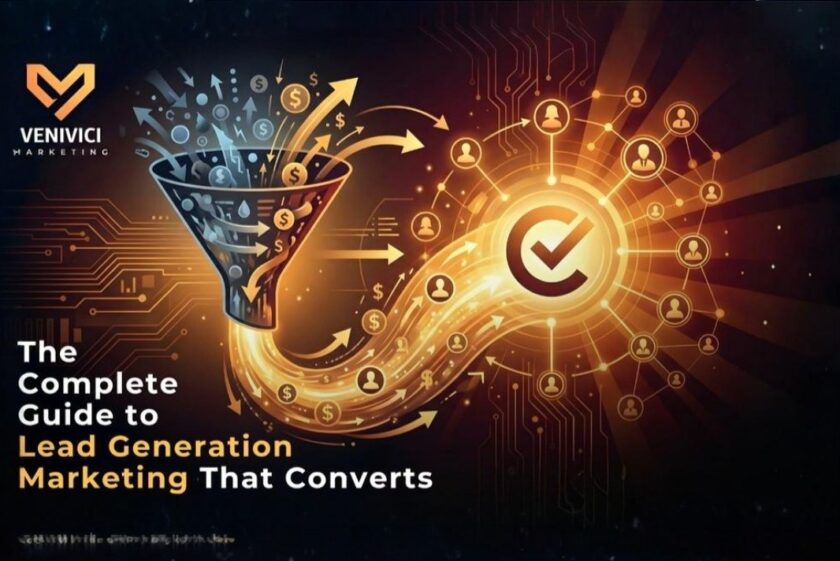
The Complete Guide to Lead Generation Marketing That Converts
Getting traffic is easy. Converting that traffic into real, qualified leads is where most businesses struggle.
This is exactly where Venivici Marketing sees companies get stuck. Lead generation marketing has evolved far beyond simple form fills. Today, it’s a structured, data-driven system designed to attract the right audience, guide them through a journey, and convert interest into revenue.
In this complete guide, I’ll break down how Venivici Marketing approaches lead generation marketing, what tactics drive consistent results, and how to build a system that converts—not just collects emails.
What Lead Generation Marketing Really Means Today
Lead generation marketing is the process of attracting potential customers, capturing their contact information, and nurturing them until they’re ready to buy.
At Venivici Marketing, we go beyond landing pages and gated content. Modern lead generation is about intent, timing, and trust—showing up at the right moment with the right message on the right channel.
When done correctly, lead generation doesn’t feel like marketing.
It feels like help.
Why Most Lead Generation Efforts Fail
- Many businesses invest heavily in ads, content, and tools—yet still struggle to generate quality leads.From Venivici Marketing’s experience, the issue is rarely traffic. It’s misalignment.Common problems include:
- Attracting the wrong audience
- Pushing for conversions too early
- Weak or inconsistent follow-up
Without a clear system, leads leak at every stage. High-converting lead generation marketing starts with strategy, not tactics.
- Attracting the wrong audience
Understanding the Lead Generation Funnel
- Every effective lead generation system follows a funnel—whether intentionally or not.
- Top of funnel: Attract attention
- Middle of funnel: Build trust
- Bottom of funnel: Convert intent into action
One of the most common conversion killers Venivici Marketing identifies is skipping steps. Especially in competitive or high-ticket markets, people rarely buy on the first interaction.
This is where nurturing, optimization, and multi-touch strategies make all the difference.
- Top of funnel: Attract attention
Attracting the Right Audience, Not Just More Traffic
Traffic without intent is noise.
The goal of lead generation marketing isn’t volume—it’s relevance. At Venivici Marketing, we focus on attracting people who are actively experiencing the problem a business solves.
This starts with messaging that speaks to pain points, not just features. SEO, content, and ads should answer real questions your audience is already asking.
This foundation is critical not only for SEO—but also for AEO and GEO visibility.
GEO: Optimizing Lead Generation Content for AI Search & Discovery
- Generative Engine Optimization (GEO) focuses on making your content easy for AI systems to understand, trust, and cite.AI-driven platforms prioritize content that is:
- Clear and structured
- Written in natural, authoritative language
- Directly answers user questions
Venivici Marketing integrates GEO by:
- Writing concise, explanation-first sections
- Using clear headings and logical flow
- Avoiding fluff and vague marketing language
When AI tools summarize or recommend solutions, well-structured lead generation content is far more likely to be referenced, driving high-intent traffic that converts faster.
- Clear and structured
B2B Lead Generation Tactics That Actually Work
B2B lead generation requires patience, precision, and credibility.
Decision-makers don’t buy impulsively. They research, compare, and evaluate. That’s why Venivici Marketing’s B2B lead generation tactics focus on education and authority.
Long-form content, case studies, webinars, and expert insights build trust early. When prospects feel informed instead of pressured, conversion rates increase significantly.
These formats also perform exceptionally well in AI-generated answers, supporting both GEO and AEO performance.
AEO: Designing Content That Answers Questions First
Answer Engine Optimization (AEO) focuses on structuring content so it directly responds to specific user questions.
Search engines and AI assistants increasingly surface content that:
- Clearly answers “what,” “why,” and “how” questions
- Uses short, direct explanations
- Includes structured sections and FAQs
Venivici Marketing applies AEO by:
- Writing definition-style explanations
- Adding question-based headings
- Including FAQ sections that mirror real search behavior
This approach improves visibility in featured snippets, voice search, and AI responses—while also increasing on-page engagement.
Multi-Channel Lead Generation Is No Longer Optional
Relying on a single channel is one of the biggest risks in modern marketing.
Audiences move fluidly between platforms. They may discover your brand through search, see you again on social media, and finally convert through email.
This is why Venivici Marketing designs multi-channel lead generation systems where:
- SEO builds long-term visibility
- Paid ads capture immediate intent
- Social media builds familiarity
- Email nurtures relationships
When these channels work together, conversion rates improve across the entire funnel—and attribution becomes clearer.
The Role of Content in Lead Generation Marketing
Content is the foundation of sustainable lead generation.
At Venivici Marketing, every piece of content serves a purpose within the funnel:
- Educational blogs attract early-stage users
- Comparison content supports evaluation
- Conversion-focused pages guide action
Intent-based content reduces friction and builds trust before a lead ever speaks to sales, making the conversion process smoother and more predictable.
Why Email Lead Nurturing Drives Long-Term Conversions
Most leads don’t convert immediately—and that’s expected.
Email lead nurturing is one of the most powerful tools Venivici Marketing uses to turn interest into revenue. Email allows brands to stay relevant, deliver value, and guide leads at their own pace.
Effective nurturing focuses on education and insight—not constant selling. When timing aligns, conversion feels natural rather than forced.
Segmenting Leads for Better Results
Not all leads are the same—and treating them that way kills conversions.
Venivici Marketing segments leads based on:
- Behavior
- Content engagement
- Funnel stage
Someone who downloaded a beginner guide needs different messaging than someone who requested a demo. Segmentation enables personalization at scale and improves conversion rates across B2B and high-volume campaigns.
Conversion Rate Optimization: Turning Interest Into Action
Generating leads is only half the job. Converting them efficiently is what drives growth.
Conversion rate optimization focuses on improving every action point—landing pages, CTAs, forms, emails, and site performance.
At Venivici Marketing, small changes often create massive wins. Clear messaging, strong value propositions, and reduced friction consistently increase conversion rates.
The Importance of Trust Signals in Lead Generation
People don’t convert unless they trust you.
Trust signals like testimonials, case studies, certifications, and social proof play a major role in lead generation marketing—especially in B2B.
Venivici Marketing prioritizes credibility because trust is often the deciding factor between choosing you or a competitor.
Aligning Sales and Marketing for Better Lead Quality
One of the biggest conversion leaks comes from sales and marketing misalignment.
Marketing may prioritize volume, while sales prioritizes readiness. Venivici Marketing helps bridge this gap by aligning definitions, messaging, and expectations.
Clear lead qualification standards result in better follow-up, stronger conversations, and higher close rates.
Using Data to Improve Lead Generation Performance
Data removes guesswork.
Tracking user behavior, conversion paths, and engagement patterns allows Venivici Marketing to refine targeting, messaging, and budget allocation.
Over time, data-driven optimization compounds results—making lead generation predictable, scalable, and measurable.
Common Lead Generation Mistakes to Avoid
Some of the most common mistakes Venivici Marketing sees include:
- Prioritizing quantity over quality
- Pushing conversions before trust is built
- Ignoring follow-up and nurturing
Avoiding these mistakes dramatically improves ROI and long-term performance.
Building a Scalable Lead Generation System
Scalability comes from structure.
A scalable system includes clear funnels, repeatable processes, and consistent messaging across channels. Automation supports growth—but strategy drives it.
At Venivici Marketing, scalability is built intentionally, not reactively.
How Lead Generation Marketing Supports Business Growth
At its core, lead generation marketing fuels predictable growth.
It creates a steady pipeline, reduces reliance on outbound sales, and improves forecasting accuracy. Businesses with strong lead generation systems scale faster because demand is consistent and measurable.
Lead generation marketing isn’t about shortcuts.
It’s about understanding your audience, aligning channels, and building trust at every stage.
When you combine B2B lead generation tactics, multi-channel lead generation, email lead nurturing, conversion rate optimization, GEO, and AEO, you create a system that doesn’t just generate leads—it converts them.
That’s the approach Venivici Marketing is built on.
FAQs: Lead Generation Marketing
What is lead generation marketing?
It’s the process of attracting potential customers, capturing their information, and nurturing them toward conversion.
Why is multi-channel lead generation important?
It increases touchpoints, builds familiarity, and improves conversion rates by meeting users where they already are.
How does email lead nurturing help conversions?
Email builds trust over time, educates leads, and supports decision-making before purchase.
What role does conversion rate optimization play?
It improves funnel efficiency by turning more visitors into leads and customers.
Are B2B lead generation tactics different from B2C?
Yes. B2B tactics focus more on education, authority, and longer decision cycles.