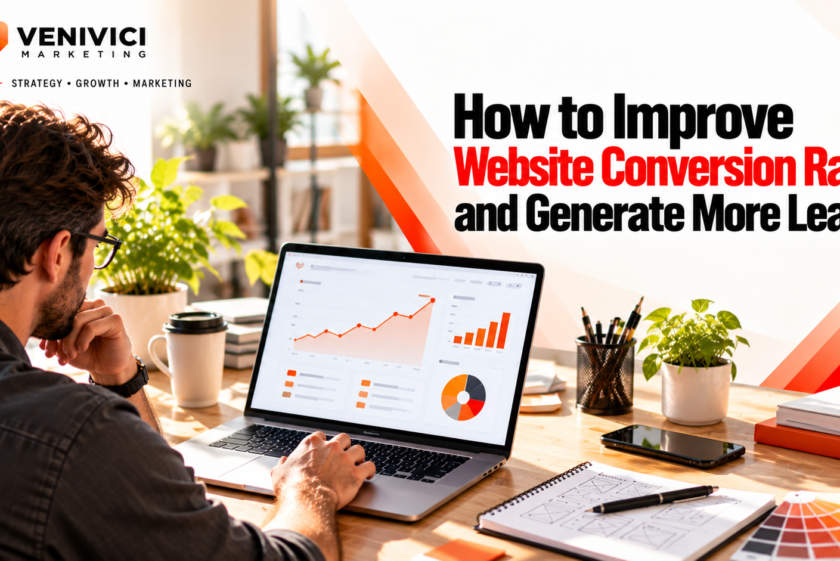
How to Improve Website Conversion Rates and Generate More Leads?
Your website plays an important role in attracting potential customers and growing your business. However, getting visitors to your website does not automatically mean they will contact you, request a quote, or purchase your services. To achieve better results, you need to turn website traffic into meaningful actions.
Improving website conversion rates involves understanding visitor needs, creating a smooth user experience, and making it easy for people to take the next step. Whether you run a small business or an established company, the right website optimization and lead generation strategies can help you make better use of your existing traffic.
In this guide, we will explain practical ways to improve website conversion rates, generate more leads, and build a stronger online presence with support from digital marketing.
What Is Website Conversion Rate Optimization?
Website conversion rate optimization (CRO) is the process of improving your website to encourage more visitors to complete a desired action. This action could be filling out a contact form, requesting a quote, booking a consultation, subscribing to a newsletter, or making a purchase.
For example, if 1,000 people visit your website and 30 submit an inquiry form, your conversion rate is 3%.
The formula is:
Conversion Rate = (Number of Conversions ÷ Total Visitors) × 100
The goal is not simply to attract more visitors. It is to help the right visitors understand your offering and take meaningful action.
1. Understand Your Target Audience
The first step toward better website conversions is understanding your target audience. Visitors are more likely to take action when your website addresses their needs and explains how your business can help.
Identify your ideal customers, their challenges, their goals, and the questions they ask before making a decision.
You can gather this information through customer feedback, website analytics, search queries, sales conversations, and market research.
For example, if your business provides professional services, visitors may want to know what you offer, how your process works, and what makes your company different.
Use these insights to improve your headlines, service descriptions, and calls to action. Your content should focus on customer needs instead of discussing only your company’s achievements.
2. Improve Your Website Design and User Experience
A confusing website can discourage visitors from exploring your services or contacting your business. Clear navigation, readable content, and a consistent design make it easier for people to find the information they need.
Focus on these improvements:
- Use a simple navigation menu with clearly labeled pages.
- Make important information easy to find.
- Use readable fonts and appropriate spacing.
- Ensure buttons and forms work properly on mobile devices.
- Remove unnecessary pop-ups and distracting elements.
- Display contact details where visitors can easily find them.
Your website should also communicate what your business does within the first few seconds of a visit.
A professional, user-friendly design can support trust and encourage visitors to explore further. If your website needs structural or usability improvements, consider Web Design and Development services to create a smoother experience for potential customers.
3. Create Clear and Compelling Calls to Action
A call to action (CTA) tells visitors what to do next. Without clear direction, people may leave your website without taking any action.
Examples of effective CTAs include:
- Request a Free Consultation
- Get a Quote
- Contact Our Team
- Book a Discovery Call
- Get Started Today
Choose CTA wording that matches the page’s purpose and the visitor’s stage in the buying process. Someone exploring your services may prefer to learn more, while a visitor comparing providers may be ready to request a quote.
Make your CTA buttons easy to notice without overwhelming the page with too many competing options. Place them near relevant service information and repeat them where appropriate on longer pages.
Test different button labels, placements, and designs to identify what works best for your audience.
4. Optimize Landing Pages for Lead Generation
Landing pages are designed to encourage visitors to take a specific action. They are particularly useful for advertising campaigns, service promotions, and targeted lead generation activities.
A strong landing page should include a clear headline, a relevant offer, concise benefits, supporting information, and a visible CTA.
For example, a company promoting SEO services could create a landing page explaining the service’s benefits and inviting visitors to request a consultation.
Keep the page focused on one primary goal. Remove unnecessary navigation or content that distracts visitors from the intended action.
Your landing page should also match the message that brought visitors there. If an advertisement promises information about a particular service, the landing page should immediately address that service.
Test different headlines, content layouts, forms, and offers to understand which combinations produce more qualified leads.
5. Make Contact Forms Simple and Easy to Complete
Contact forms are an important part of website lead generation, but complicated forms can discourage potential customers from submitting their information.
Ask only for details that you genuinely need at the initial stage. For many businesses, a name, email address, and short inquiry may be enough to begin a conversation.
If additional information is necessary, explain why you are requesting it. Make field labels clear, display helpful error messages, and ensure the form works properly on mobile devices.
You should also provide a clear confirmation message after submission so visitors know their inquiry was received.
For businesses looking to build a more consistent pipeline of prospects, Lead Generation services can support strategies for attracting and converting potential customers.
6. Attract Relevant Traffic Through SEO and Paid Advertising
Website conversion rates depend partly on the quality of your traffic. Visitors who are genuinely interested in your products or services are generally more relevant than people who arrive without a related need.
Search engine optimization (SEO) can help your website appear for searches related to your offerings. Create useful service pages, answer customer questions, improve page titles, and make your website easy for search engines to understand.
Explore Search Engine Optimization to support your organic visibility and reach people searching for relevant services.
Paid advertising can help you reach specific audiences and test offers more quickly. However, your ads should target suitable prospects and direct them to relevant landing pages.
Learn more about PPC and SEM Marketing to support targeted traffic acquisition.
The key is to align your traffic sources with your conversion goals. More traffic is useful only when it reaches the right audience and has a clear path toward becoming a lead.
7. Use Content Marketing to Build Trust
Visitors may not be ready to contact your business the first time they discover it. Helpful content can answer their questions, explain your expertise, and help them make informed decisions.
Consider publishing blog articles, service guides, frequently asked questions, case studies, and educational resources related to your audience’s needs.
For example, a marketing agency might publish a guide explaining how businesses can improve their online visibility or generate qualified leads.
Include relevant internal links that direct readers to related service pages. This helps visitors discover your offerings naturally and gives them a clear next step when they are ready.
Avoid making unsupported claims or promising guaranteed results. Use accurate information and genuine examples to build credibility.
Veni Vici Marketing offers Content Marketing to help businesses create relevant content that supports brand awareness and audience engagement.
8. Build Relationships Through Email Marketing
Not every visitor will convert during their first visit. Email marketing can help your business maintain contact with people who choose to subscribe or request further information.
Offer useful resources, relevant updates, newsletters, or educational content that gives people a reason to stay connected.
Segment your audience where appropriate so subscribers receive messages related to their interests and needs. For example, someone who downloads a marketing guide may benefit from additional educational emails about website optimization.
Keep your emails clear, useful, and consistent with your brand. Include relevant CTAs that guide readers toward the next step, such as exploring a service or booking a consultation.
Always obtain appropriate consent and follow applicable privacy and email marketing requirements.
Explore Email Marketing Services to support ongoing communication with potential customers.
9. Use Marketing Analytics to Measure Performance
You cannot improve website conversion rates effectively without understanding how visitors behave on your website.
Track important metrics such as:
- Website sessions and traffic sources.
- Conversion rate by landing page.
- Contact form submissions.
- Calls and consultation requests.
- Cost per lead from advertising.
- Qualified leads and eventual sales.
Tools such as Google Analytics 4 and Google Search Console can help you understand website traffic and visitor activity. Form tracking and advertising reports can provide additional information about conversions and campaign performance.
Look for pages that receive traffic but generate few inquiries. Review their messaging, page experience, CTA placement, and relevance to the visitor’s search intent.
Use the findings to prioritize improvements. For reliable decision-making, measure qualified leads as well as total submissions, because not every inquiry will become a customer.
Veni Vici Marketing’s Marketing Analytics Reports can support businesses in evaluating marketing performance and identifying areas for improvement.
10. Test, Learn, and Improve Continuously
Conversion rate optimization is an ongoing process rather than a one-time website update.
Start with the pages that matter most to your business, such as service pages, high-traffic landing pages, and contact forms. Identify one potential issue, make a focused change, and measure the result.
For example, you could test a clearer headline against the existing version or compare a shorter contact form with a longer one.
Whenever possible, use controlled A/B tests with enough data to make a meaningful comparison. Avoid changing many elements simultaneously, because it becomes harder to understand which change influenced the results.
Remember that results can vary depending on traffic quality, audience behavior, industry, and the offer itself. Keep testing and use the evidence to guide future decisions.
Conclusion
Improving website conversion rates and generating more leads requires a combination of audience research, user-friendly design, clear calls to action, optimized landing pages, relevant traffic, and useful content.
By simplifying contact forms, measuring performance, and continuously testing improvements, businesses can make their websites more effective at turning visitors into potential customers.
Veni Vici Marketing provides services including web design and development, SEO, PPC and SEM marketing, content marketing, lead generation, email marketing, and marketing analytics. Combining the right services with a clear conversion strategy can help your business strengthen its online presence and create more opportunities to connect with qualified prospects.